
Building appsBeginner · about 15 minFree · no signup
Explore editable 3D worlds with WorldClaw
Explore Tencent’s world-generation research, then plan a small scene with separate, editable assets.
By Alan Brown
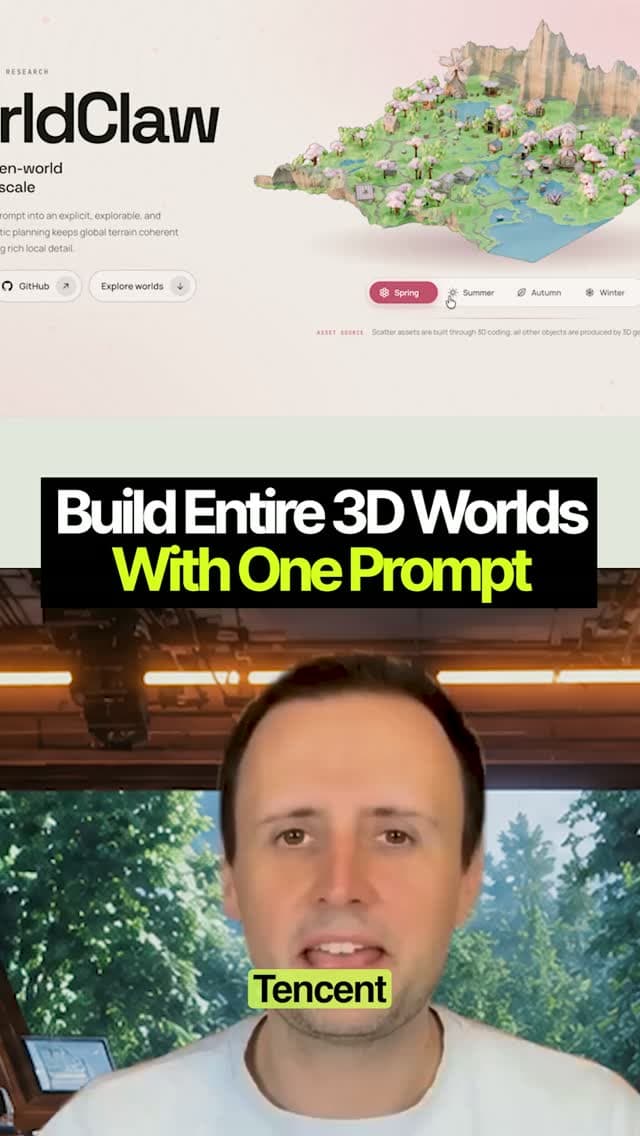
🌍 Tencent’s WorldClaw explores generating large 3D environments from a text prompt, with editable assets that creators can reuse.
- 🏘️ Imagine a snowy village with houses, trees and lampposts, or a desert environment for your next game.
- 🧭 The research describes agents planning regions, terrain, materials and objects, then building and refining the scene.
- 🧩 The paper reports editable assets at the individual-instance level. That does not guarantee that every surface is a separate object or that the result is ready for a game or robot simulator without further work.
- 🔗 Explore the official demonstrations: tencent-hunyuan.github.io/Hunyuan3D-WorldClaw/
- 📄 Read the research: arxiv.org/abs/2608.05248
- 💻 Check releases: github.com/Tencent-Hunyuan/Hunyuan3D-WorldClaw — checked 9 October 2026: the paper and project page are public; the repository does not provide a runnable world-generation release.
Context & limitations
Would you use this to build your own game? Start with the scene-planning prompt below while watching the official repository for release updates. This prompt was written for the guide.
Do this yourself
MY WORLD
Theme: ___ (default: a snowy village) Purpose: ___ (default: a small exploration game) Target editor or game engine: ___ (ask if missing)VERIFY FIRST
Check the official project, paper and repository: https://tencent-hunyuan.github.io/Hunyuan3D-WorldClaw/ https://arxiv.org/abs/2608.05248 https://github.com/Tencent-Hunyuan/Hunyuan3D-WorldClaw State the date checked. Separate research demonstrations from a usable public application, released generation code, model weights and licensed assets. Do not invent an installation command or imply that a public repository proves the full system is available. If browsing is unavailable, ask me for source text.PLAN A FIRST SCENE
Ask one question at a time if clarification is necessary. Keep the first scene to a 50-by-50-metre area, three small buildings and no more than five reusable prop types. Give me: 1. A short scene description and a simple top-down layout in metres. 2. An asset table with names, quantities, approximate dimensions, materials, reuse opportunities and which objects must remain individually editable. 3. One concise environment prompt and a separate generation brief for each reusable asset type. These are proposed briefs, not verified WorldClaw command syntax. 4. A five-step implementation plan for the editor I chose, starting with a blockout using simple shapes. If WorldClaw cannot be run publicly, clearly label the practical alternative workflow. 5. An inspection checklist covering scale, object separation, collisions, traversable paths, mesh quality, texture consistency, performance and asset licences. Keep terrain, buildings and props logically separate. Do not promise that every surface in a research scene is a standalone object or that an attractive scene is already a finished game. Explain what additional physics and validation a robotics simulation would require. Finish with the smallest useful task I can complete today.Use an AI with web access to check availability and produce a scene brief. This prompt plans the world; generating assets needs a supported 3D tool.
Want to build this with a teacher?
Pathwise Academy runs small, hands-on AI classes in Singapore for ages 10–17 and adults.