
Separate a working prototype from a staged demonstration
4.6 metres, 100kg, one rider, no CGI — and three minutes at two metres off the ground. The shot that made him famous was fishing line and bamboo poles, and that was the right order to build in.
By Alan Brown
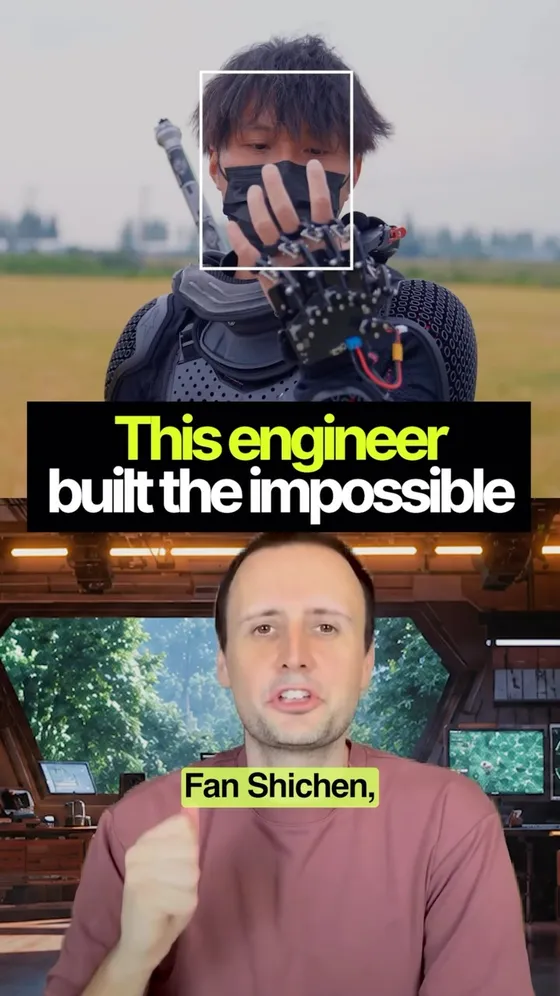
4.6 metres. 100kg. One human rider. Zero CGI. 🗡️ A Chengdu creator just unveiled a flying sword — a real one, controlled by a sword-shaped lever, carrying a person through the air.
- 🛠 He started in 2020 with sword-shaped quadcopters nobody took seriously. By 2024 he had built a hovering platform big enough to stand on.
- 🧤 By December 2025 he was flying around thirty drone swords at once, controlled through motion-sensing gloves that track hand gestures in real time.
- ⚖️ His latest build cracked the hardest problem of all: a sword shape is a nightmare to balance in the air. His four-man team spent 18 months on it.
- 🇨🇳 Even Chinese foreign ministry spokesperson Mao Ning praised the result.
- 💰 The wild part? He never sold any of it. A former hotel employee, he funded the whole thing out of his own savings.
- ⚔️ His next goal? 10,000 swords moving as one — straight out of wuxia fiction.
- 👇 The prompt below is the part the story skips: the order he actually built in, and how much of it was string.
Context & limitations
First, the name, because it will cost you ten minutes otherwise. Everywhere he is actually covered — Xinhua, CGTN, SCMP, Vice — he is 范十三, Fan Shisan, "Fan Thirteen", and that is a handle rather than a birth name. Search the name in the video and you get almost nothing; search the handle and you get everything, including two Guinness certificates and a spot on state television. Worth knowing before you go looking for the primary sources.
The manned flight is real and it is smaller than it sounds. 4.6 metres and about 100kg are right, and the sword lifts a rider up to 70kg — so it carries a person, but not a person plus much else. The published figure is roughly three minutes in the air at about two metres off the ground. The first manned attempt, on New Year's Day, lasted four or five seconds: it started shaking at under half a metre, tipped when he moved his arm, put him on the floor, and he only got it stable by crouching. Two months of all-nighters for five seconds. That is the honest shape of "carrying a person through the air", and it is more impressive with the numbers in, not less.
The ten thousand swords are not a future goal. He already did them — in October 2024, with real swords on steel cable and bamboo poles, after earlier passes with fishing line left the rigging visible in shot (穿帮 is the word the Chinese coverage uses). One version hung six to seven thousand blades; the headline version, ten thousand. What is at thirty is the drone version, and Vice and Futurism both watched the December swarm video and counted "10+". So the real goal is ten thousand aircraft flying in formation rather than ten thousand props on wire, and those are not the same project — they are not even the same discipline. The swarm already needs its own ground station for charging, take-off and landing.
"Never commercialised" is the line I would change. He has close to five million followers, two Guinness World Records (one is five sheets of A4 cut in mid-air in 7.46 seconds), an appearance on CCTV's 2026 Spring Festival Gala broadcast, film and TV productions approaching him for prop work, talks around a 仙剑 anniversary concert, and a team that has gone from four to seven. SCMP's write-up says plainly that he hopes to see the prototype mass-produced one day; he describes it as still in development, not as something he refuses to sell. The savings he spent are influencer savings. None of that makes him a fraud — it makes him someone whose product is the video and whose sword is the thing the video is about, which is a real business model and the one actually worth copying.
And the engineering choice underneath all of it is the one the prompt is built on. A sword is a terrible airframe: a standard quadcopter is a symmetrical cross, and a blade is a long, thin, wildly unbalanced thing with the mass in the wrong place. He solved it with carbon fibre and brute force — twenty ducted fans, which did not give enough thrust, then twenty-four. Any competent engineer would have told him to widen the shape. But the shape was the only part anyone cared about, so the shape had to be real on day one, and everything else — the flight time, the altitude, the autonomy, the ten thousand — was allowed to stay on wires for six years. That is the whole trick, and it is not a story about drones.
Do this yourself
A clearly disclosed prototype can test the core experience before every supporting feature is automated. See Prototype before you hire anyone.
Want to build this with a teacher?
Pathwise Academy runs small, hands-on AI classes in Singapore for ages 10–17 and adults.