
Analyse how an AI product grows beyond its first use
Solar collars, boundaries drawn in a phone app, and 6,000 data points a minute off every animal. The fence was only ever the wedge.
By Alan Brown
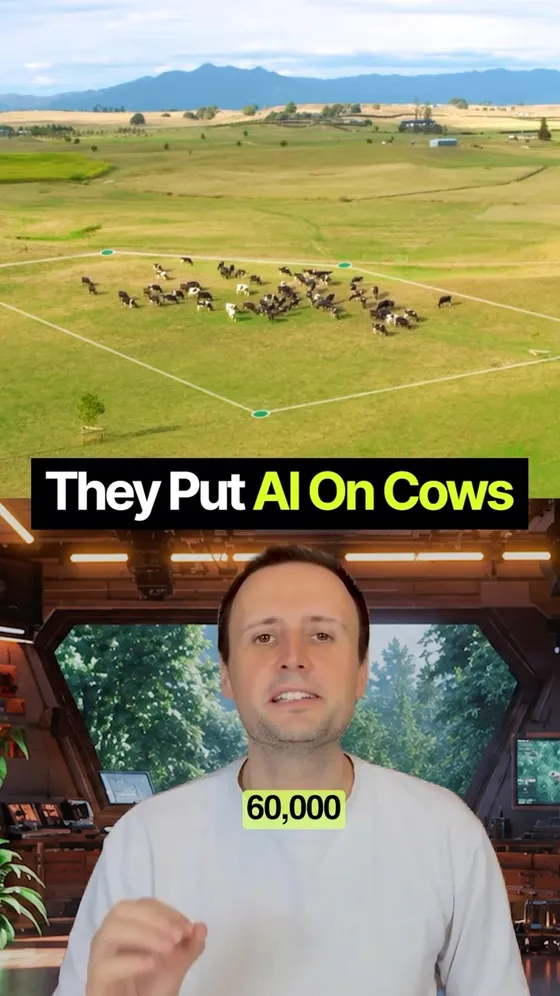
800,000 km of fencing. Zero posts. $2 billion. New Zealand startup Halter makes AI smart collars that build virtual fences for cattle. No wire. No posts. Just a collar and an algorithm.
- 📱 Farmers draw boundaries in a phone app, and the collars guide cows with sound and vibration cues to keep them in set areas.
- 🧠 Here's the smart part — each collar pulls 6,000+ data points a minute, feeding models that track grazing, predict disease, and flag peak breeding times.
- 📈 The payoff: 20+ hours of labour saved a week, hundreds of thousands of kilometres of fencing replaced across NZ, Australia and the US, and 2,000+ farms and counting — over a million collars now live, on roughly two million cattle.
- 👨🌾 Founder Craig Piggott grew up on a dairy farm in Matamata watching his parents work 100-hour weeks. So he built the fix. Founded 2016; the company's now worth over $2 billion after a US$220m round led by Peter Thiel's Founders Fund, who also backed the Series A back in 2017.
- 🛰️ And in 2026 they did something genuinely new: collars that talk straight to satellites, so a ranch no longer needs towers on the hills to use it.
- 🌍 Half the world's habitable land is farmland. This could change how all of it gets managed.
Context & limitations
The bit the clips leave out is that it isn't only sound and vibration. If an animal ignores the cues, the collar delivers a low-level electrical pulse — Halter is open about this in its own Animal Welfare Charter and puts it at roughly a tenth the strength of a conventional electric fence, predictable enough that a trained cow can avoid it entirely by turning at the beep. That is a reasonable design, and probably gentler than the hot wire it replaces. But "no wire, no posts" invites people to hear "no aversive at all", and that isn't what's happening.
Two numbers I could and couldn't stand up. The 6,000 data points a minute is Halter's own published figure. The labour saving they publish is "over 20 hours per week", so the 20 is solid and the 40 is the top of a range I couldn't source. And the last fencing total I could actually find is 568,000km, from their 2025 year in review — 800,000 is entirely plausible now, given collars went from about 700,000 live at the end of that year to over a million today, but I couldn't source it.
The land figure is worth getting exactly right, because it makes the point harder rather than softer. Our World in Data puts agriculture at 44% of habitable land — "almost half" — but two-thirds of that farmland is grazing, and once you add the cropland grown to feed animals, livestock accounts for about 80% of all agricultural land while supplying 17% of the world's calories. So the surface this technology actually addresses isn't half of farmland. It's most of it.
Do this yourself
Accumulation is useful only when it improves an outcome enough to justify its cost and collection.
Want to build this with a teacher?
Pathwise Academy runs small, hands-on AI classes in Singapore for ages 10–17 and adults.