
Understand what happens when you send an AI prompt
Your words leave as pulses of infrared light in a cable on the seabed, cross an ocean at 125,000 miles a second, and come back as tokens.
By Alan Brown
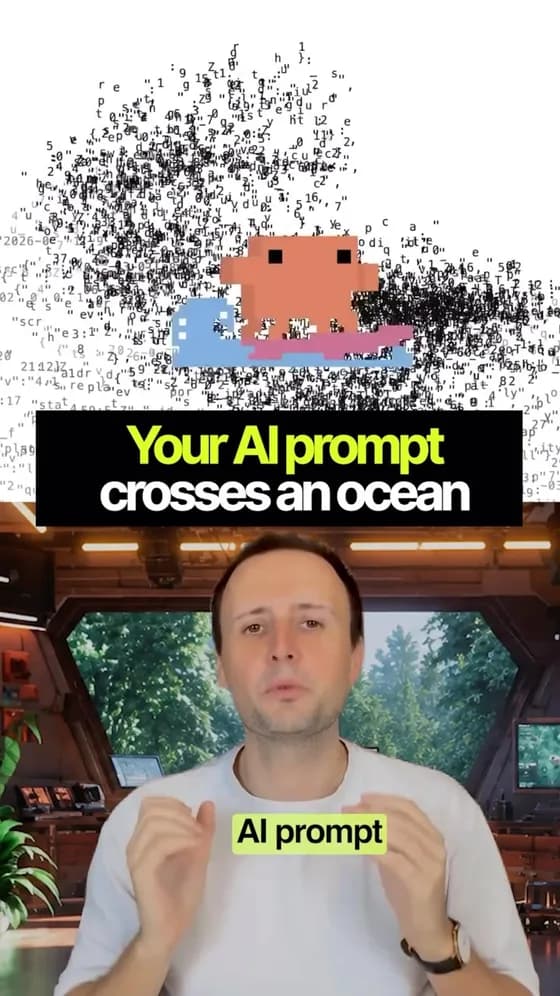
Your prompt crosses an ocean and comes back before you finish blinking. Here's what physically happens when you hit send.
- 📦 Your words become zeros and ones, then get chopped into tiny packets. They leave your device, hit your router, run down fibre to your ISP's regional hub, and shoot toward the data centre.
- 💡 And if that data centre is on another continent? Your prompt turns into pulses of infrared light, fired through cables lying on the ocean floor — around 1,550 nanometres, well outside anything your eyes can see. There's a map of every one of them: www.submarinecablemap.com/
- 🌊 Light moves through glass at roughly 125,000 miles per second, so thousands of miles takes about 40 to 80 milliseconds. The glass is what slows it: fibre has a refractive index near 1.47, which puts light in a cable at about two-thirds of its speed through a vacuum.
- 🖥 Then it lands. Routed to a specific rack packed with GPUs and TPUs, reassembled, fed to the model.
- ⚡ Here's the interesting part: you never sit staring at a blank screen. The GPU produces the answer bit by bit, and the server ships each chunk out the moment it exists. That's why the words appear as they're being written.
Context & limitations
40 to 80 milliseconds is a transatlantic number, not a universal one. The working rule is about 10ms of round trip per 1,000km of cable, and New York to London runs near 59ms on the fastest dedicated route — close to the physical floor. Singapore to the US west coast is 13,000-14,000km of cable, which is roughly 130ms of round trip before anything else happens; real connections measure higher again, because routing, switching and queuing all take their cut on top of the glass. From here the ocean costs you at least double what the video's figure suggests.
And you do stare at a blank screen — just briefly. That gap has a name, time to first token, and most of it is the model READING your prompt rather than the ocean carrying it. Claude Haiku 4.5 has been measured at about 597ms to its first token on a medium prompt, so even from Singapore the whole round trip is somewhere between a fifth and a third of that wait, and the rest is compute. Streaming hides the length of the answer, not the start of it.
It also arrives token by token rather than bit by bit, a token being roughly three-quarters of a word. The reason it reads so naturally is that the model writes faster than you read: about 6 tokens a second matches normal reading speed and most models are comfortably past that, so the text is waiting for you rather than the other way round.
Do this yourself
Separating mechanisms, estimates and measured delays makes the explanation easier to verify. See Understand a word everyone else seems to know for the vocabulary first.
Want to build this with a teacher?
Pathwise Academy runs small, hands-on AI classes in Singapore for ages 10–17 and adults.