
Compare components before changing your coding agent
MIT, free, and every part swappable — the model, the tools, the memory, even the agent loop. 208k GitHub stars in under three weeks.
By Alan Brown
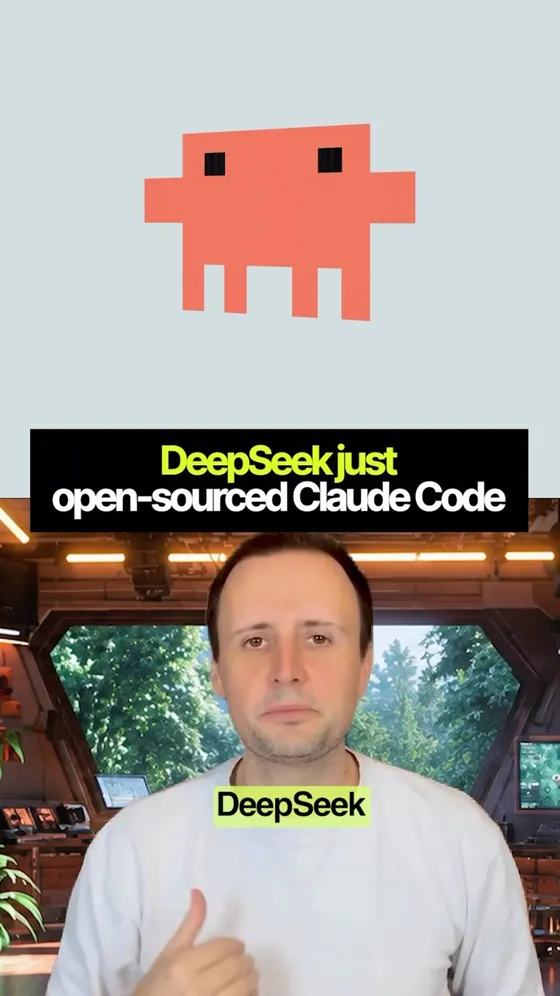
27,000 GitHub stars on day one. 95,000 by day two. 165,000 in a week. DeepSeek dropped their own free, open-source answer to Claude Code, and it's called DeepSeek Harness.
- 🔌 The difference is that everything inside it is a plugin. The model, the tools, the memory, even the agent loop itself. Swap out whatever piece you want and build your own agent from scratch — the repo's own one-line description is literally "Everything is a Plugin": github.com/deepseek-ai/deepseek-harness
- 🧩 The docs list the plugin categories as models, tools, skills, sessions, sandboxes, storage, loops, scheduling and the UI. There's no privileged core to patch — extending it means mounting another plugin beside the rest.
- 🧠 Which means any model, including locally: DeepSeek, Anthropic, OpenAI, or any OpenAI-compatible endpoint on your own network. And you can call Claude Code and Codex sub-agents from inside it, which turns them into tools rather than rivals.
- 📄 MIT licensed, completely free, written in TypeScript. One command to run it: npx @deepseek-ai/dsh web — it opens a web UI at 127.0.0.1:3080.
- 📈 The repo went up on 13 August 2026. As of today it's on 208,898 stars and 24,365 forks, so the 165,000 in the video is already out of date in the right direction.
Context & limitations
The 53 tools is a real number but not the one you get on launch. The generated tool catalog covers 25 plugin packages and 63 tool registrations — 53 once you drop the experimental Agent Teams package, which ships disabled — but a lot of those packages are opt-in, and how many the model actually sees depends on the preset. There are four: Standard, PTC, Minimal and Creator. Boot the default web session and the model is offered 26 tools. Minimal offers exactly two: bash and str_replace_editor.
The part nobody's posting is DeepSeek's own safety notice, and it's blunt. This is developer-preview software that has NOT had a security audit, it runs model-generated code and commands, it loads third-party plugins, and it reaches your files, processes, credentials and network. Their words: sandboxing and approval prompts "do not guarantee isolation", so run it with least privilege in a disposable VM or container and keep backups. Expect compatibility-breaking changes — the README shouts that in capitals.
Locked down is out, swappable is in — but swappable means you're now the one assembling it, and that's the real trade. Worth knowing too that free harness doesn't mean free model: DeepSeek raised its own API prices in August, and V4-Pro off-peak is roughly double what developers were paying before. Still far below Claude Opus, and you can point it at a local model for nothing — which is rather the point of a plugin you can swap.
Do this yourself
Locate the problem before swapping the tool; keeping the current setup is a valid outcome.
Want to build this with a teacher?
Pathwise Academy runs small, hands-on AI classes in Singapore for ages 10–17 and adults.