
EverydayBeginner · about 15 minFree · no signup
Check a photo's perspective and shadows for signs of AI
Real photos obey perspective: parallel lines meet at one point, and so do shadow lines in sunlight. Here's how to test a viral picture yourself.
By Alan Brown
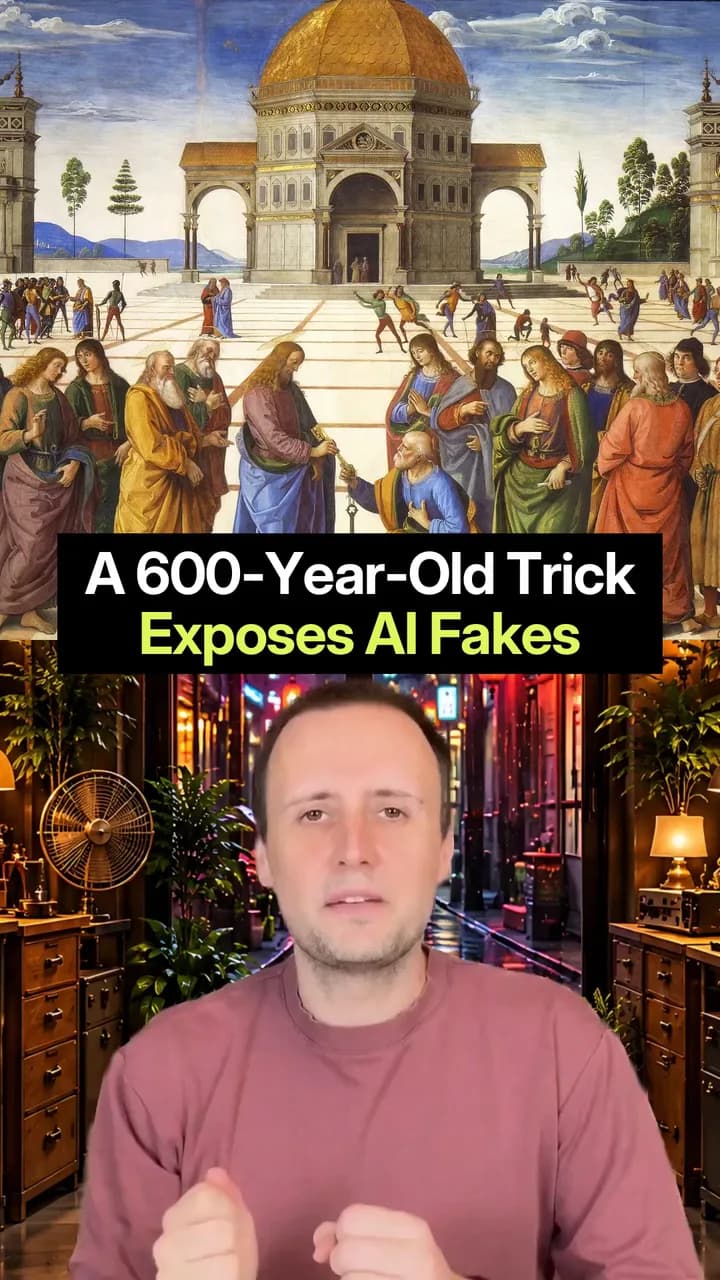
📐 A 600-year-old art trick can expose AI fake photos.
- 🛤️ In a real photo, parallel lines like floor tiles, rail tracks and road edges all meet at one vanishing point.
- ☀️ Shadows work the same way: draw a line from an object to its shadow and in real sunlight every line meets at one point.
- 🤖 AI doesn't draw lines. It predicts pixels. Extend the lines in a fake and they miss.
- 🔬 It's the method Hany Farid, Berkeley's "godfather of digital forensics", uses, as covered in Science magazine's "Reality Check" by Kai Kupferschmidt: www.ischool.berkeley.edu/news/2026/science-magazine-highlights-prof-hany-farids-deepfake-detection-efforts
- 🖼️ Credits (Wikimedia Commons): Sather Tower – Coolcaesar (CC BY-SA 4.0); railway – PinchyCC (CC BY 4.0); road – W.carter (CC BY-SA 4.0); gallery floor – Jorge Royan (CC BY-SA 3.0); tree shadow – temporalata (CC BY-SA 2.0); printing presses – Harrison Keely (CC BY 4.0); newspaper press – Vanuatu Daily Post (CC BY 3.0); UC Berkeley aerial – UC Berkeley (CC BY 3.0); train driver's view – European Train Driver (CC BY 3.0); newsroom – Daily Nebraskan (CC BY 3.0). Perugino painting public domain; corridor and AI-generated city images CC0.
Context & limitations
Save this before the next viral "photo" hits your feed. Geometry is one clue, not proof on its own, and the prompt below walks you through the check.
Do this yourself
Needs an AI that can read images. A geometry check is one clue, not a verdict, so the prompt keeps it alongside source and context checks.
Want to build this with a teacher?
Pathwise Academy runs small, hands-on AI classes in Singapore for ages 10–17 and adults.