
School & studyBeginner · about 10 minFree · no signup
Could plastic waste become a cookie?
Explore the µBites research and use AI to separate laboratory results from future possibilities.
By Alan Brown
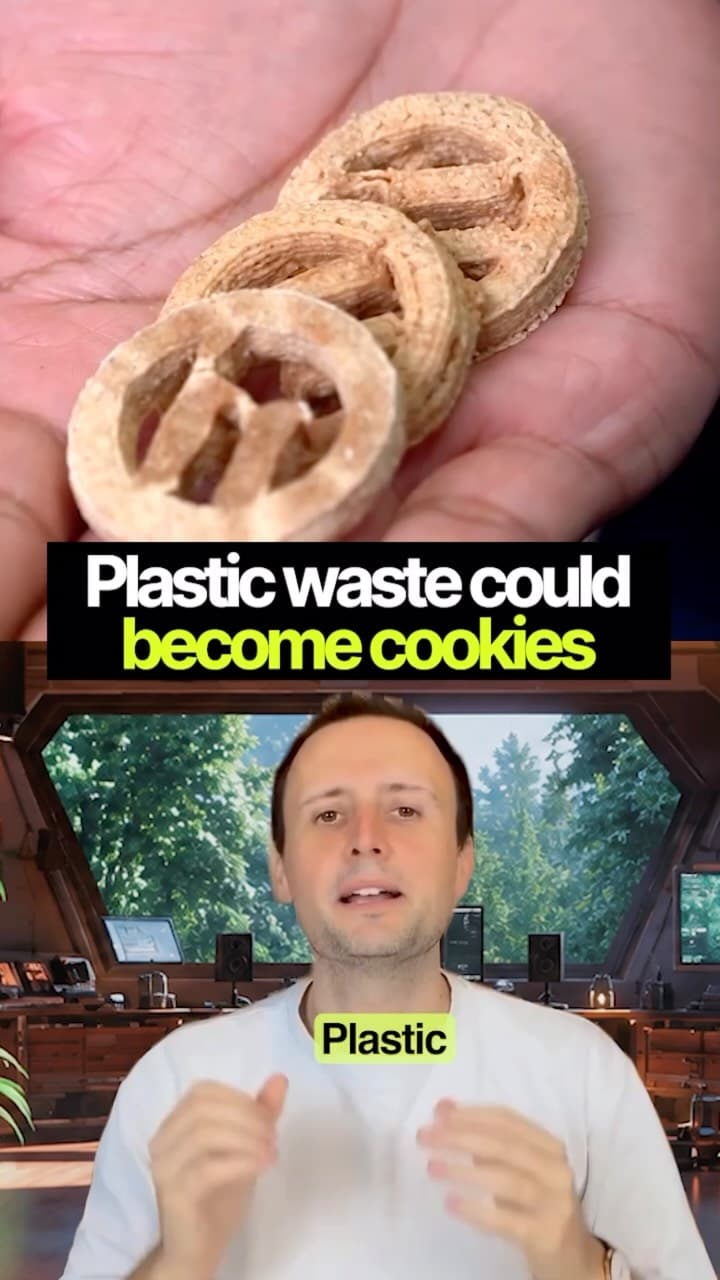
🍪 Scientists are exploring how to turn plastic waste into food ingredients. Imagine turning yesterday’s plastic bottle into tomorrow’s vanilla cookie.
- ♻️ Researchers at Southern Illinois University are developing µBites (“microbites”), using both plastic and agricultural waste.
- 🧬 Heat, pressure, water and oxygen break down the feedstocks; engineered yeasts convert the resulting molecules into useful ingredients.
- 🍦 The reported work includes vanilla flavouring from plant material and beta-carotene, a vitamin A precursor, from a PET-derived compound.
- 🍪 Additions such as fibre, starch and sweetener help form the 3D-printed cookie prototypes.
- 🚀 The research received NASA Deep Space Food Challenge funding. Space missions are a potential application; this is still experimental.
- 🔎 ACS reported on 24 August 2026 that the team was awaiting institutional approval for taste tests. That is not a statement of FDA approval. Read the research summary: www.acs.org/pressroom/presspacs/2026/august/this-cookie-started-its-life-as-a-plastic-bottle.html
Context & limitations
Use the prompt below to investigate the evidence and remaining questions. Would you eat a cookie made with ingredients recovered from waste?
Do this yourself
START WITH SOURCES
Read the American Chemical Society research summary: https://www.acs.org/pressroom/presspacs/2026/august/this-cookie-started-its-life-as-a-plastic-bottle.html Find related primary research, Southern Illinois University project material and official NASA sources. State the date of your check. If you cannot browse, ask me to paste the sources and do not invent citations.EXPLAIN THE PROCESS
In no more than 150 words, explain the path from waste feedstocks to smaller molecules, microbial conversion, food ingredients and cookie prototypes. Distinguish plastic-derived inputs from plant-derived inputs and added ingredients. Explain why recovering carbon does not by itself prove a food is safe.CHECK THE CLAIMS
Build a table with these columns: claim, evidence, source and date, what remains unknown. Check the project name, feedstocks, yeast products, NASA's role, taste-testing status and any regulatory claims. Distinguish institutional approval for taste tests from FDA approval. Separate a conference presentation, a peer-reviewed result and a proposed future application. Do not describe it as food already eaten by astronauts unless a primary source establishes that.MAKE IT USEFUL
Give me five questions a student should ask about safety, energy use, scale, nutrition and environmental impact. Finish with a 60-second explainer for a general audience and three accurate headline options. Keep this educational: no home production or consumption instructions. Link each factual claim to its supporting source and label uncertainty.Use an AI with web access to build a sourced explainer and distinguish demonstrated results from proposed uses.
Want to build this with a teacher?
Pathwise Academy runs small, hands-on AI classes in Singapore for ages 10–17 and adults.