
Evaluate the limits of workplace AI monitoring
Green boxes are the customers. Blue lines are the staff. The software knows how long the break really ran — and who picked something up and put it back.
By Alan Brown
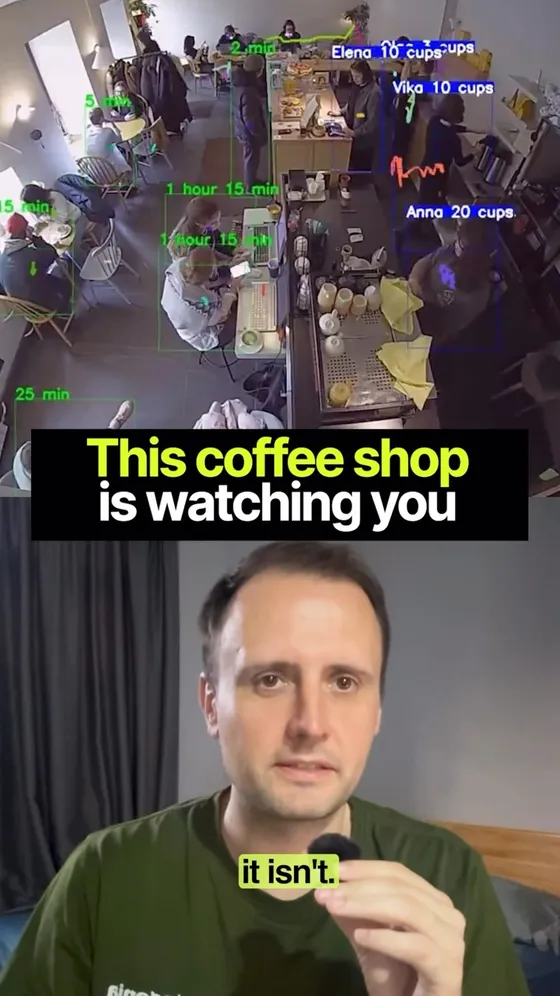
That barista doesn't know it, but a camera just logged her 47th coffee of the shift. ☕ Every camera in the store is running AI, 24/7.
- 🟩 The green boxes? Each one's a customer — the software knows exactly how long they've been sitting. The blue lines? That's the staff. Movement, output, drinks-per-hour, and how long that lunch break really ran.
- 📹 It's called NeuroSpot — computer vision that tracks and analyses humans inside physical stores. Sounds dystopian. But as the owner, it's gold.
- 🌧 It cross-references footfall against the weather, so you stop over-ordering fresh stock for a rainy Tuesday nobody shows up for.
- 🤔 It counts the people who picked something up, hesitated… and put it back — a price objection nobody ever says out loud.
- 🔔 It even pings staff that a shelf's empty before a single customer notices.
- 👀 Nobody's opinion. Just what the camera saw. The future of retail is watching — the only question is whether you're the one holding the data.
Context & limitations
First thing worth knowing: this is a demo, and it's older than it looks. NeuroSpot filmed and posted it themselves — it was already doing the rounds by 1 February 2024 — so what you're watching is a vendor showing off its own "Barista Staff Control and Customer Monitoring" module, not a coffee shop that went out and bought one. It resurfaces every few months and lands as news every time.
Second thing: NeuroSpot's website is gone. neurospot.tech was live in November 2024, was showing the registrar's domain-expired notice by May 2025, and today is a parking page offering the domain for sale. The technology is real and a dozen other vendors sell the same modules — but the specific company everyone is still arguing about looks like it folded while the clip kept going.
Their own archived retail page backs up most of the caption: shelf-gap alerts sent to staff, movement heatmaps able to "distinguish between employee and customer interaction with goods", queue detection that tells the office to open another till, and till-fraud analysis of every transaction "from cash counting to receipt deletion". It also lists one module the video never shows — shoplifting detection that is "not only facial, but it also responsive to body postures and gestures", which adds a person's photo and history to a database used "across the whole company network". A tool that counts coffees and a tool that maintains a face database across every branch of a chain are not the same product, and only one of them gets reposted.
The one claim I couldn't stand up is the weather. Overlaying footfall on weather to stop over-ordering is genuinely standard in this category — but I couldn't find it in anything NeuroSpot published, so take it as something the technology does rather than something this product did.
And if you're a Singapore owner thinking about it for your own shop, the law is more specific than the vibes. The PDPC's advisory guidelines treat CCTV footage as personal data. For customers in a public-facing area you can rely on the publicly-available exception, and a notice is "good practice" (para 4.34). For staff, read 4.39: you may rely on the employment exception instead of asking consent, but only if you have already told them what the camera is for, in the handbook or an HR policy they can actually reach. So the question was never whether you're allowed to count her coffees. It's whether she was told, in writing, before you started — which is step 6 of the prompt above, and the reason it's in there.
Do this yourself
Drop-off shows what happened; testing competing explanations helps establish why.
Want to build this with a teacher?
Pathwise Academy runs small, hands-on AI classes in Singapore for ages 10–17 and adults.