
Work out which risky tasks a robot could take on
China's State Grid is sending robots up to live power lines while the operator stays on the ground. Work out which risky tasks in your own job a robot could take on.
By Alan Brown
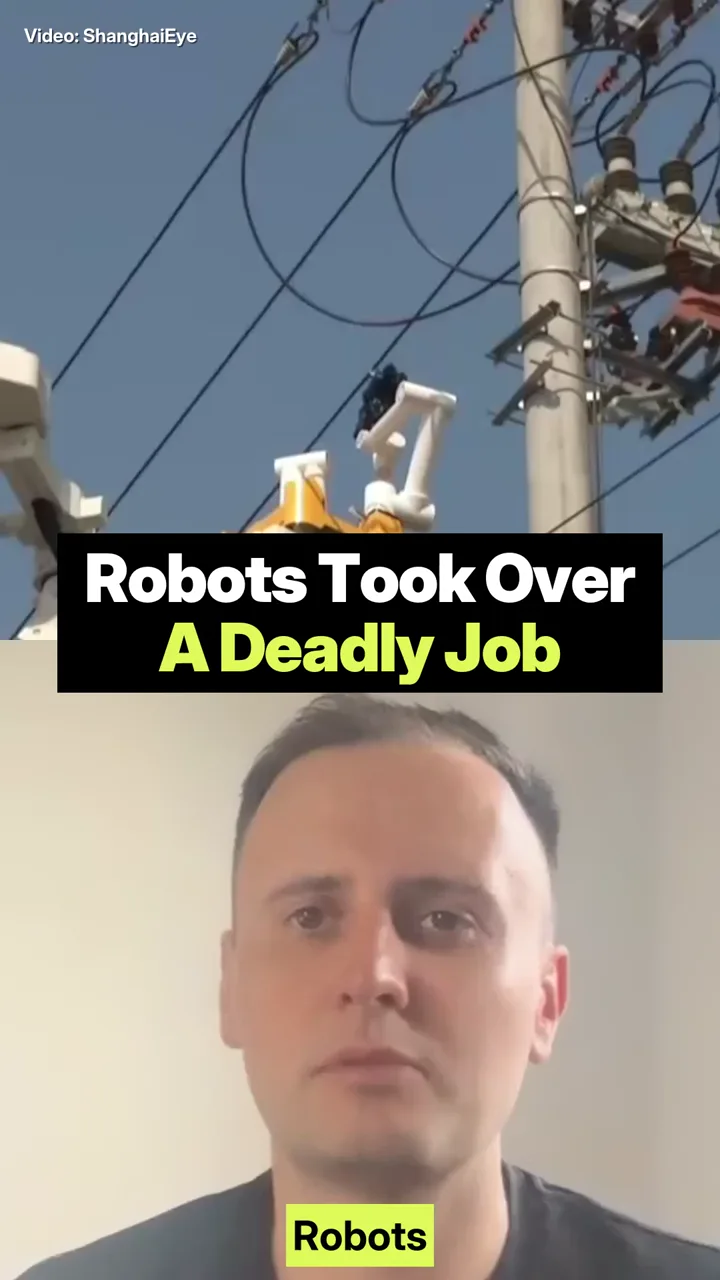
⚡ Robots are now doing one of the most dangerous jobs in the world.
- 🤖 In China, State Grid is sending robots up to live 10,000-volt (10 kV) power lines, and fixing them while the power stays on.
- 🚚 A bucket truck lifts the robot to the line. The operator stands on the ground with a remote, watching through the robot's HD cameras.
- 🔧 The robot strips the insulation, lines up the parts and tightens the bolts, with no power cut for the homes nearby.
- ⏱️ In a January trial in Tianshui, it installed a set of grounding rings in about 25 minutes, against about 60 minutes for a manual crew: subsites.chinadaily.com.cn/gansu/2026-01/19/c_1155797.htm
- 🏔️ State Grid has since used them at almost 3,000 m altitude in Gansu: news.cri.cn/20260427/37f441e3-9751-408f-b616-0902f52455e1.html
- 🇮🇱 Israel Electric Corporation now uses a drone with a robotic arm to fit warning markers on high-voltage lines instead of helicopters: www.jpost.com/business-and-innovation/article-896735
Context & limitations
These are early deployments and trials, not every line crew yet, and a person still controls the robot. But it takes people out of the danger zone, and the prompt below helps you see where the same shift could reach your work.
Do this yourself
Robots are arriving first in the most dangerous parts of jobs, not the whole job. Breaking your own work into tasks and rating each for risk shows where help could land first and what skills stay valuable.
Want to build this with a teacher?
Pathwise Academy runs small, hands-on AI classes in Singapore for ages 10–17 and adults.