
Separate facts, incentives and opinions in an AI debate
Four months at Anthropic against a six-month cliff, so nothing vested at all. Two of the caption's closing beats don't hold up either — Huang never called it nonsense, and Sanders and Bannon never shared a stage.
By Alan Brown
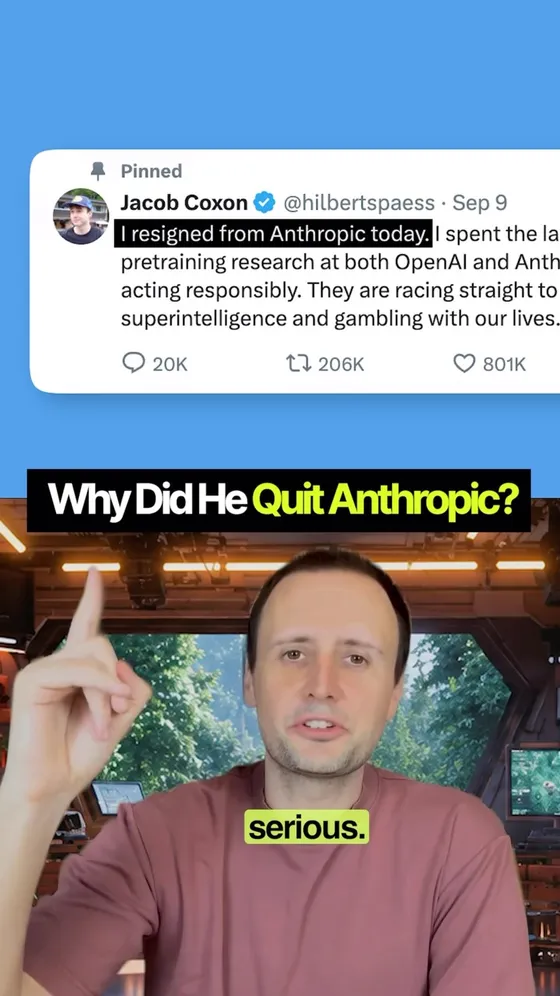
27 years old. One park bench. 🪑 Jacob Coxon resigned from Anthropic on 8 September 2026 and posted about it from Alamo Square in San Francisco, and the industry spent the next week arguing about it. Most of the caption checks out. The money detail is understated, and two of the closing beats aren't right.
- 🧾 The credentials are exactly right. Three years of pretraining research across both labs, and OpenAI's own GPT-4o contributor list names him.
- 💸 The equity is bigger than the caption says, not smaller. He was four months into Anthropic against a six-month vesting cliff — his words were "I left before any of my equity vested." Not a reduced payout. None of it.
- 📈 The view count was a moving target all week: 70M+ by 9 September, 115M+ on the original post, and 153M inside 36 hours by TIME's count. 90M was true somewhere in the middle.
- 🗣️ Jensen Huang didn't call it complete nonsense. Trump did the dismissing — "It's a hoax" — patched in by speakerphone at the All-In Summit, and Huang's reply was "You're right. We're not going to let that happen, sir."
- 🎙️ Sanders and Bannon never shared a stage. They spoke moments apart at the Pro-Human Assembly — same event, separate slots, which is a smaller and more believable thing.
- 🚪 The two who followed were Joe Benton, who led a safety research team at Anthropic, and Josh Engels, who worked on AI safety at Google — not OpenAI. Both went to METR, the evaluation nonprofit.
- 👇 The prompt below is for the state the caption leaves you in: a room of credentialed people shouting past each other.
Context & limitations
The fact the caption skips is the one that makes the week make sense. Dario Amodei's response wasn't a sympathetic post, it was a roughly 3,900-word essay proposing that labs slow capability work until safety research catches up, that third-party evaluators be embedded inside the labs themselves, and that the coordination extend to international limits between democratic and authoritarian governments. Altman agreed publicly, pledged OpenAI would give independent evaluators employee-level access, and ruled out a 2026 IPO — pushing the most anticipated listing in tech to 2027 at the earliest. Musk endorsed it too. Three CEOs who compete directly agreeing in the same week is the actual event, and it is almost never mentioned by the posts retelling this.
What makes that genuinely hard rather than merely noble: Anthropic is itself moving toward a Nasdaq listing. CNBC's framing was a tightrope — calling publicly for an industry slowdown while pursuing your own IPO is a position that has to be held very carefully, because the slowdown you are advocating is priced into the thing you are about to sell. That is not hypocrisy on its face, and it is exactly the sort of tension worth naming out loud instead of picking a team over.
The most striking voice isn't the CEO or the leaver, it's the person who stayed. Evan Hubinger, an alignment science lead at Anthropic, publicly put the chance of AI killing all humans within the decade at greater than 10 percent — while continuing to work there. Read carelessly that looks like a contradiction. It's actually Coxon's whole argument, stated by someone who drew the opposite conclusion from it: the stakes are understood inside the building, and the race continues anyway. Coxon was explicit that he has not seen Anthropic compromise safety to outrun a competitor; his worry is prospective, that racing pressure eventually cuts corners and skips oversight, and that fear of OpenAI and of China becomes the reasonable-sounding excuse for pushing ahead. "They're not evil" is true and softer than what he actually said, which is more specific and more useful.
Which is why the prompt attached to this one isn't a fact-check. Almost nobody in this story is wrong about the facts — they have the same information and different exposure. Huang sells the hardware a slowdown would slow. Altman and Amodei were both steering companies toward public markets. Coxon, four months in and nothing vested, had the least to lose of anyone quoted and said so. Trump has a midterm. None of that makes any of them wrong, and this is the trap: noticing an incentive feels like winning an argument, and it isn't one. It only explains why the argument doesn't resolve. The useful question for a story like this is never who's right — it's what would have to be true for each of them to change their mind, and whether anyone in the room has an answer to that at all.
Do this yourself
Separating evidence, values and documented incentives avoids both false balance and speculation about motives.
Want to build this with a teacher?
Pathwise Academy runs small, hands-on AI classes in Singapore for ages 10–17 and adults.