
Identify the bottleneck behind an AI infrastructure claim
Five times the largest building on Earth, in a Texas field — because Musk says the whole world's chip output covers 2% of what his own companies need.
By Alan Brown
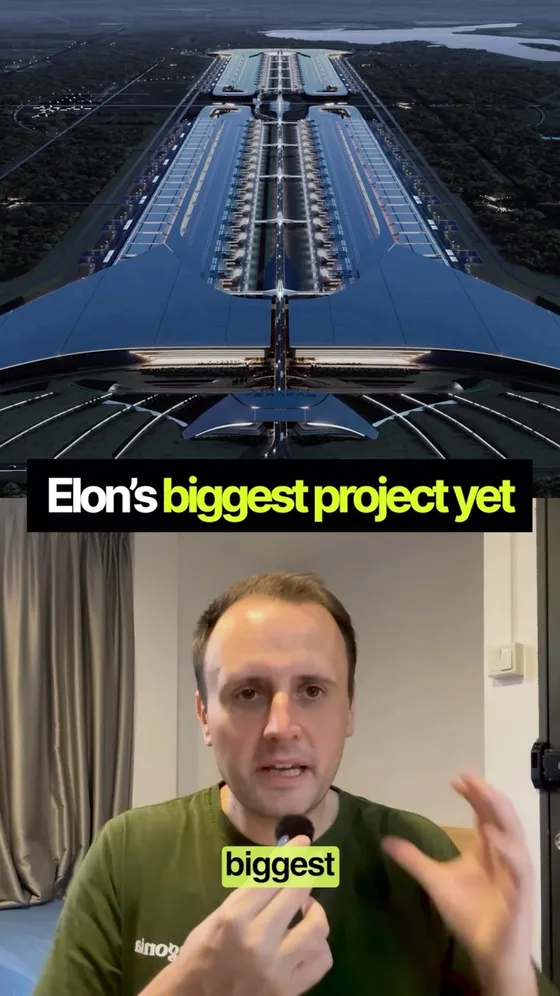
100 million square feet. 1,700 football fields. One building. Elon's Terafab isn't 5% bigger than the largest building on Earth — it's five times bigger. Drop it on Manhattan and it covers nearly three times Central Park, sitting in a field in Grimes County, Texas.
- 📏 The comparison holds up. The largest building on Earth by floor area is the New Century Global Center in Chengdu at about 18.9 million square feet; 100 million is 5.3 times that. It's roughly 2,300 acres of floor, or 2.7 Central Parks.
- 🔌 But the size isn't the wild part. The reason he's building it is. Musk says the entire world's chip output covers about 2% of what his companies will need — not 2% of the market, 2% of what Tesla, SpaceX, xAI and Optimus need internally.
- 🗣 His words: "We either build the Terafab, or we don't have the chips, and we need the chips, so we build the Terafab."
- 🔗 So this was never a play to disrupt the chip industry. It's the only way to keep the companies he already owns alive — and when it's done, he owns his own supply chain.
- 🛰️ At full scale: 1 terawatt of compute a year, roughly 50x the world's current AI chip output, from a target of 100–200 billion chips. He's said about 80% of it is earmarked for orbit — radiation-hardened chips for solar-powered data centres in space.
- 🏗 Where it actually is: Grimes County, Texas, an hour northwest of Houston. Phase one is $16.8bn, construction 2026–2028, with early production possibly from 2027 and at least 3,000 jobs.
Context & limitations
The $16.8bn is phase one of four. Texas filings describe a four-phase build totalling around $119bn if SpaceX finishes the whole thing — and the number has already moved once: the March announcement led with $25bn, which quietly became a "$16.8bn initial phase" with the rest left vague. Nothing is being manufactured there today; the concrete is the story so far.
Two things worth holding lightly. The 2% is Musk's own figure for his own projected internal demand, not a measured one — and a big share of that demand is Optimus at a scale that doesn't exist yet. And "owns his entire supply chain" isn't quite it either: Intel signed on to help design, fabricate and package the chips, so the vertical integration has a very large partner inside it.
The part nobody posts is the subsidy. SpaceX has filed a stack of tax-incentive applications on this site, and told the state that without the break, competing jurisdictions "would present a more favorable after-tax return". A project framed as pure existential necessity is simultaneously arguing it might go elsewhere over tax. Both of those can be true at once — but only one of them is the version that goes viral.
None of which makes the plan small. Build the biggest building in history, to make 50x the world's chips, to launch them into space, to run the AI that powers everything down here. Never bet against Elon — just read the phase number before you quote the price.
Do this yourself
Impact, time to disruption and uncertainty make dependency planning actionable without treating estimates as arithmetic facts.
Want to build this with a teacher?
Pathwise Academy runs small, hands-on AI classes in Singapore for ages 10–17 and adults.