
Choose an AI certificate — and build proof of your skills
Alan’s tier list, with who each option suits, what the credential actually shows and a prompt to plan your next project.
By Alan Brown
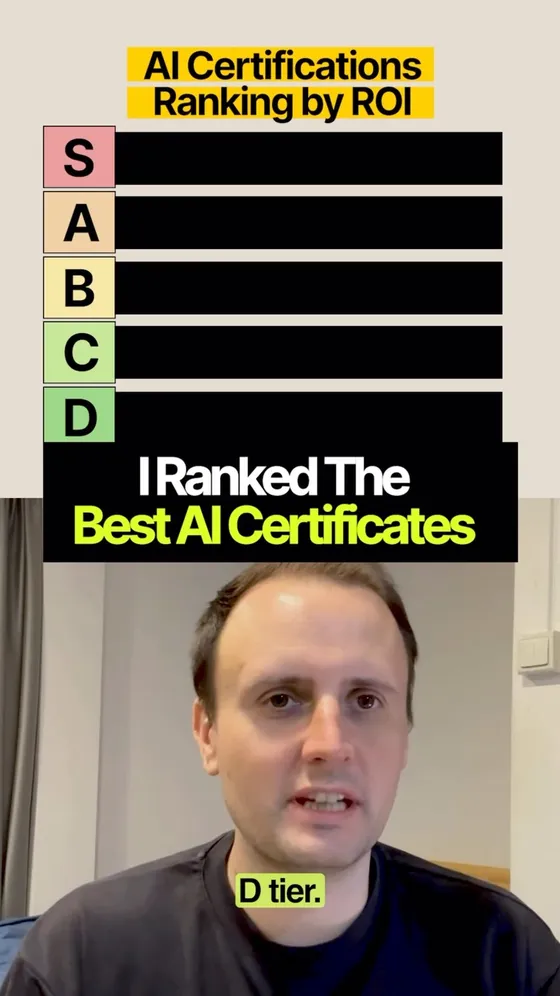
Choose the skills you need before choosing a badge. A beginner course, a business certification and a technical exam serve different goals; the highest tier is not automatically your best next step.
- Start with your goal: everyday AI confidence, business decisions, or building and deploying systems. Check the prerequisites and current local price on the provider’s page before enrolling.
- Pair the learning with a small project. Show the problem, your working demo, how you tested it and what still needs improvement.
The certificate tier list
Provider details checked: 21 September 2026
These are Alan’s editorial tiers from the video, not an independent ranking of teaching quality or hiring outcomes. The supplied caption says nine certificates but names seven options; all seven are covered here. Course completion and passing a certification exam are different forms of evidence. Neither alone proves someone can deliver a production system.
Generic Udemy AI certificates
Course completion • varies by instructor
Best for: A specific skill taught by an instructor whose syllabus, sample lessons and projects match your needs. A lower badge ranking does not make every course poor.
Trade-off: Udemy is not an accredited institution. The completion certificate is not a standardised AI qualification; assess the actual course and the work you produce.
Official provider details ↗ — Generic Udemy AI certificatesCareer Essentials in Generative AI by Microsoft and LinkedIn
Learning-path certificate • introductory
Best for: Getting oriented in generative AI, its workplace applications and responsible use before choosing a more specialised path.
Trade-off: This learning-path credential is different from a Microsoft role-based certification exam. Add a practical example of applying the learning to demonstrate your ability.
Official provider details ↗ — Career Essentials in Generative AI by Microsoft and LinkedInGoogle AI Essentials
Course certificate • no technical experience required
Best for: Beginners who want hands-on practice with AI tools, prompting and everyday work tasks.
Trade-off: It teaches foundations rather than ML engineering or production deployment. It is a different credential from Google Cloud’s certification exams.
Official provider details ↗ — Google AI EssentialsDeepLearning.AI — Generative AI with Large Language Models
Technical course • Python background recommended
Best for: Learners ready to understand how LLMs work, including transformers and fine-tuning, and connect that knowledge to applications.
Trade-off: It is a course, not a professional certification exam. Its technical prerequisites make it a less suitable first stop for someone new to programming.
Official provider details ↗ — DeepLearning.AI — Generative AI with Large Language ModelsGoogle Cloud Generative AI Leader
Certification exam • business-level knowledge
Best for: People making business decisions about generative AI, with an emphasis on Google Cloud’s offerings and adoption strategies.
Trade-off: Passing demonstrates exam knowledge, not coding or deployment experience. The Google Cloud focus may be less relevant if your work uses another ecosystem.
Official provider details ↗ — Google Cloud Generative AI LeaderAWS Certified Machine Learning Engineer — Associate
Certification exam • technical ML engineering
Best for: Practitioners working with AWS ML systems, from data and models to deployment, monitoring and operations.
Trade-off: AWS recommends relevant hands-on experience. The exam is a useful knowledge signal, but production competence still needs practical evidence; it is not a beginner AI-tools course.
Official provider details ↗ — AWS Certified Machine Learning Engineer — AssociateClaude Certified Architect — Foundations
Technical certification • Claude application architecture
Best for: Solution architects building production applications with Claude. Anthropic introduced this exam through the Claude Partner Network.
Trade-off: It is specific to the Claude ecosystem. Check current eligibility and the exam syllabus through Anthropic; a credential alone does not establish job demand or guarantee employment.
Official provider details ↗ — Claude Certified Architect — Foundations★ Build something people can use
Our recommendation: build a small agent, app or tool for a real task, then ask someone to try it. Keep a demo, a short explanation of your decisions and results from realistic tests, including failures. A project complements a relevant certificate; it does not replace a qualification an employer requires.
Do this yourself
The recommendation follows your goal and constraints, and ends with evidence of a skill you can demonstrate.
Want to build this with a teacher?
Pathwise Academy runs small, hands-on AI classes in Singapore for ages 10–17 and adults.